

ATU President and Iranian Ambassador to Moscow meet to reinforce academic diplomacy
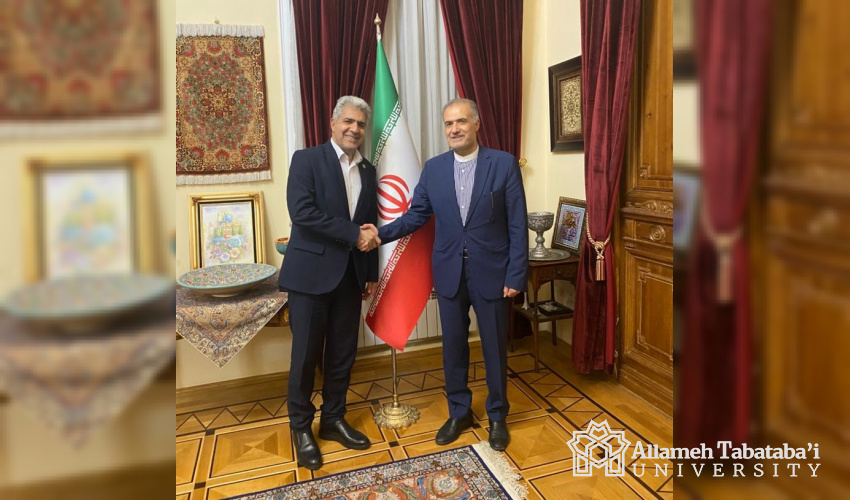
Report by Directorate for International Academic Cooperation—
Translated into English by Rasoul Firouzi
The President of Allameh Tabataba'i University and the Iranian Ambassador to the Russian Federation met to discuss strengthening scientific ties and exploring how academic institutions can assist state governance and public understanding regarding international issues.
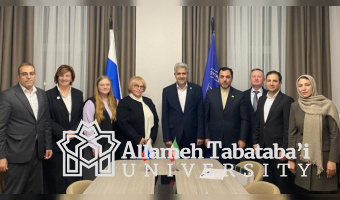
During his visit to Russia, Dr Shoja Ahmadvand, President of Allameh Tabataba'i University (ATU), led a delegation in a meeting with Dr Kazem Jalali, the Ambassador of the Islamic Republic of Iran to the Russian Federation.
The discussions centered on enhancing scientific and academic relations between Iran and Russia, the pivotal role of the university in academic diplomacy, and strategies for leveraging academic insights to inform governance and public opinion on international affairs and neighborhood relations.
Dr Jalali welcomed the ATU delegation and underscored the importance of academic diplomacy. He stated, "By relying on theoretical knowledge and engaging actively in international forums, universities can play an instrumental role in rectifying public misconceptions regarding foreign relations and generating a more precise understanding of international agreements."
The Ambassador further noted that academic expertise is invaluable for addressing challenges between Iran and its neighbors, particularly concerning transit corridors, multilateral relations, and the resolution of misunderstandings in regional interactions.
Expressing his gratitude to Dr Jalali, Dr Ahmadvand outlined several key initiatives of ATU. "Over the past decade, ATU has served as the premier hub for humanities and social sciences cooperation between Iran and Russia," Dr Ahmadvand remarked. "We are currently the only university to have established three joint degree programs with Russian institutions, including Moscow State Linguistic University and North Ossetia State University."
Dr Ahmadvand added that the university's Center for Teaching Persian to Speakers of Other Languages (CTPSOL) is fully prepared to offer Persian language courses to Russian universities and learners, both in-person and online. He suggested that the Embassy’s promotion of these capabilities would significantly contribute to the expansion of cultural ties.
Highlighting the university’s capabilities in Computer Science, Statistics, and Mathematics, Dr Ahmadvand expressed a keen interest in expanding joint collaborations in emerging fields such as Artificial Intelligence, FinTech, Data Science, and Machine Learning. He also affirmed the university's readiness to organize specialized workshops and meetings for visiting Russian faculty and students.
Dr Ahmadvand concluded by detailing the university’s recent policy shift towards "problem-oriented" scientific engagement. "In the past nine months, ATU has convened 15 specialized problem-solving sessions, the results of which were submitted as policy recommendations to the country’s executive and administrative bodies," he explained. "A significant portion of these recommendations addressed international issues and relations with neighboring countries, receiving positive feedback from the government, ministers, and officials across all three branches of government."
 Soroush